The Dancing Plague of 1518: When an Entire City Danced Until It Collapsed
In July 1518, a woman stepped into a street in Strasbourg and began to dance. She did not stop for days. Within weeks, dozens and perhaps hundreds of her neighbours were moving the same way, and the city's remedy only made things worse. This is the story of one of the strangest episodes in European history, and of the historians who are still arguing about what really happened.
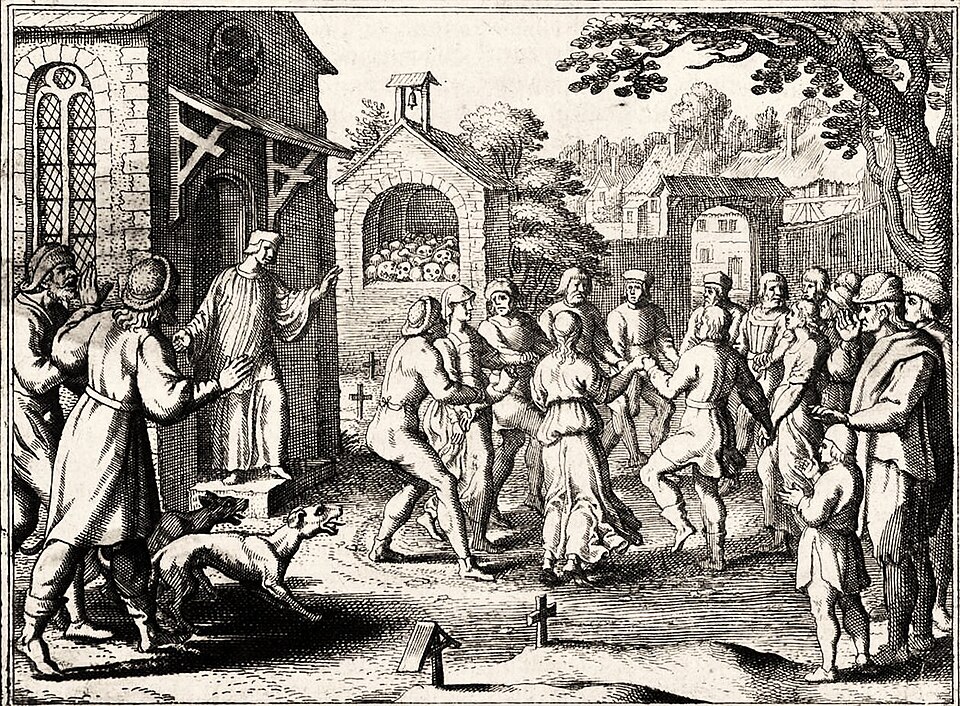
A woman in the street
On 14 July 1518, a woman walked out of her half-timbered house in Strasbourg and started to dance. There was no music and no festival. She was not celebrating anything. Neighbours watched as she kept going for hours, then for days, pausing only to collapse and sleep before getting up and dancing again.
Historians know her as Frau Troffea. Her first name was never recorded, and the chronicles of the time do not even agree on how to spell her surname. Almost everything else about her is lost. What survived is the chain of events she set off. Strasbourg was then a free city of the Holy Roman Empire, a busy trading town on the Rhine. Today it lies in eastern France. In the summer of 1518 it was also a frightened place, and that matters for everything that followed.
A city already on edge
The years before 1518 had been hard. Harvests had failed more than once. Floods had ruined fields. Grain prices had climbed, and hunger was common. Bubonic plague and syphilis were also circulating, leaving many families sick or in mourning. Fear had a religious shape as well. In this part of Europe, people believed that Saint Vitus could punish sinners by making them dance uncontrollably. His name even turned up in everyday curses. Many townspeople also distrusted their priests, whom they thought corrupt, which left them anxious about whether the sacraments could protect them. A ready-made story about a dancing curse was already part of local belief. All it needed was someone to start.
The dancing spreads
Within about a week, around three dozen other people in the city had begun to dance. By August, depending on which source you trust, the number had grown to somewhere between 50 and 400. Dancers were seen in the streets and market squares. Some collapsed from exhaustion and then rose to continue.
Frau Troffea herself was carried off after four to six days. The city council sent her by wagon to the shrine of Saint Vitus at Saverne, roughly thirty miles away, so that the saint who had cursed her might also cure her. By most accounts she recovered.
The council now faced a much larger problem. It turned to physicians for advice, and the doctors answered in the medical language of their day. In the humoral theory that guided medicine at the time, illness came from imbalances in the body's fluids. The dancers, they decided, had overheated blood. The natural remedy was to let them dance it out.
A remedy that backfired
The authorities acted on that advice with energy. They had a stage built. They hired musicians. They cleared guild halls so that the afflicted had space to move, and they brought in strong men to hold up anyone who began to fall. From the point of view of the time, this was a careful and caring response.
It did the opposite of what was intended. A public stage with music drew crowds, and crowds drew more people into the spectacle. The historian John Waller has argued that the decision to put dancers on show in the most public places in the city was a disaster, because it carried the affliction to more people.
The council changed its mind. Public dancing and drumming were banned. The city also moved against gambling and prostitution, on the theory that Saint Vitus was angry about the sins of the town. Those who were still dancing were loaded onto wagons and sent to the shrine at Saverne.
Red shoes at the shrine
Accounts of the pilgrimage describe a solemn ritual of prayer and blessing. The dancers were given red shoes that had been touched with holy water, and were then placed before a carved figure of the saint. News of the apparent cures travelled back to Strasbourg, and more dancers were sent. Within a few weeks the stream of pilgrims had dwindled. By early September the outbreak had faded.
How many died?
Popular retellings say that people danced until their hearts gave out, and that some died of strokes or exhaustion. This is possible, but the evidence is thinner than the story suggests. The surviving council records of Strasbourg do not mention any deaths at all. The accounts that do speak of fatalities came later, and the numbers for the dancers themselves vary widely.
What the sources agree on is the shape of the episode. The outbreak ran from mid July to early September. Most chronicles name Frau Troffea as the first dancer. The council built the stage, hired the musicians, and finally sent people to Saverne. Physicians, preachers and city officials all wrote about it, and the physician Paracelsus described it in the following decades. The dancing is certain. The death toll is not.
What was it?
There are three main explanations, and none of them settles the matter.
The first is ergot poisoning. Ergot is a fungus that grows on rye and can cause convulsions and hallucinations. It has been blamed for other historical panics. But Waller and others point out that someone poisoned by ergot would struggle to dance for days. Not everyone would react in the same way, and there is no sign of an ergot outbreak in Strasbourg that year. Dancing manias also clustered along the Rhine and the Moselle, where climates and crops differed. Most historians now reject this theory.
The second is mass psychogenic illness, sometimes called mass hysteria. This is the explanation most scholars favour today. It holds that extreme stress, combined with a deep and widely shared belief in a dancing curse, pushed people into a trance-like state in which the movement felt beyond their control. Waller describes the dancing as an expression of desperation and religious fear. In this view the council's stage and musicians were not a cause of the first dancing, but they helped it spread.
The third is a combination of the two ideas above. Waller has suggested that no single trigger is required. Years of hardship, a culture that expected such a curse, and an official response that amplified it can explain both why the dancing began and why others copied it. The Strasbourg outbreak was not the first. Other cases of so-called dancing mania had been reported across central Europe since the Middle Ages, and several occurred in the same region along the Rhine. Strasbourg's is simply the best documented. It was also among the last.
Why it still fascinates us
The story has never stopped inspiring artists. Engravings by Hendrik Hondius depict dancers caught in the mania, and the Brueghel family painted dancing processions in the same tradition. In recent years the episode has shaped a 2020 short film by Jonathan Glazer called Strasbourg 1518, a song by the band Ghost, and a 2023 novel by Kiran Millwood Hargrave called The Dance Tree. The most striking part of the tale may be how reasonable the city's behaviour was by its own standards. The council followed medical advice. It then followed religious advice. It tried, in sequence, everything its world told it to try. The result was a summer that no one in Strasbourg could explain, and which historians still cannot fully explain five centuries later.
Further reading
John Waller, A Time to Dance, a Time to Die: The Extraordinary Story of the Dancing Plague of 1518 (Icon Books, 2008).
John Waller, "A forgotten plague: making sense of dancing mania," The Lancet 373 (2009), 624 to 625.
Lynneth J. Miller, "Divine Punishment or Disease? Medieval and Early Modern Approaches to the 1518 Strasbourg Dancing Plague," Dance Research 35 (2017), 149 to 164.
Ned Pennant-Rea, "The Dancing Plague of 1518," The Public Domain Review (2018).