The Order That Would Not Die: The Real Story of the Illuminati
In 1776 a young law professor founded a small secret reading society in Bavaria. It was outlawed within a decade, yet its name now stands for a world-controlling cabal that the historical record does not support.
The story, as it is usually told, begins with a thunderstorm. In the summer of 1785 a priest named Johann Jakob Lanz walked out of the free imperial city of Regensburg with an old friend, a fugitive professor who had slipped into town that February disguised as a craftsman. The sky darkened, the storm broke, and lightning struck Lanz dead on the road. Later accounts say that papers found on his body urged the banned order to carry on in secret, and that the friend he had been visiting was Adam Weishaupt, founder of the Illuminati. Whether the lightning really handed the order's secrets to its enemies is another matter. Historians who have picked the tale apart point out that it has been retold so often, and with so many embroideries, that the priest acquires new names, new journeys and new deaths from one book to the next. Even careful accounts disagree on the exact date, on whether Lanz was a member at all, and on how much his papers mattered, since the strike came months after the first edicts against the order had already been issued. Still, the scene deserves its place at the head of this story, because it captures what the Illuminati have always been: a small, earnest, rather bookish company of men whose real history is full of ordinary detail, and whose legend keeps absorbing drama that never happened. What follows is the history and the legend together, and the strange journey by which a society broken up before the French Revolution began came to be blamed for almost everything that came after it.
A professor with a plan
Adam Weishaupt was born in 1748 in Ingolstadt, a university town in the Electorate of Bavaria, and he never quite left it. His father, a law professor, died when the boy was five, and the child passed into the care of his godfather, Johann Adam von Ickstatt, who was also a professor of law at Ingolstadt. At seven he began his schooling with the Jesuits, who then ran much of Bavarian education, and the training was thorough enough to shape the rest of his life: later admirers and enemies alike noticed how much the order he founded borrowed the discipline, the hierarchy and the habit of obedience that he had learned in a Jesuit classroom. He took up the law himself and became a professor at the university in 1772, later holding the chair of canon law, and in 1775 he came across the empirical philosophy of Johann Georg Heinrich Feder of Göttingen, which gave him a vocabulary for the suspicion of authority that he already felt. The irony of his position was plain to everyone around him. He was a rationalist teaching Church law at a Catholic-controlled university whose administrators he found overbearing. On the first of May 1776, at the age of 28, he gathered four friends and founded a secret society. He first called it the League of Perfectibilists, a name that points to the belief at its centre, that human beings could be improved by education and by moral effort, and in April 1778 he settled on the title by which it would be known, the Order of the Illuminati. The early structure was modest, with three grades called novice, minerval and illuminated minerval. The middle grade was named for Minerva, the goddess of wisdom, and was the only one with a real ceremony, in which the candidate received secret signs and a password. By 1778, on paper at least, the membership stood at about twelve. It was less a conspiracy than a club for clever young men who wanted to read what they were not supposed to read, and who dreamed of a Bavaria freed from what they regarded as the tyranny of the Church, with reason and equality in its place. Later historians have pointed out a further irony, which is that the order prescribed in great detail what its members were to read and think, so that the independence of judgment it praised was exactly what its own rules discouraged.
Borrowed robes
A reading club of a dozen students could not change a kingdom, and Weishaupt knew it. What he lacked was numbers, meeting places and a taste for ritual, and all three were available in the Masonic lodges that dotted German-speaking Europe. He was himself initiated into a Munich lodge, Theodor zum guten Rath, in 1777, and from then on the plan was to grow inside Freemasonry rather than beside it. In 1780 he sent an agent, the Marquis de Costanzo, to spread the order in the north, and Costanzo showed material on the minerval grade to a young nobleman who would change everything. Adolph Freiherr Knigge was still in his twenties, yet he had already climbed to the highest grades of another Masonic system and arrived with ambitious ideas for reforming Freemasonry as a whole. He and three friends were curious; his friends soon lost interest, but Knigge persisted, and in November 1780 Weishaupt wrote to him. Knigge agreed to recruit on one condition, that he could choose his own hunting grounds, and he proved a brilliant salesman. Masons who were tired of the squabbles and the shaky mythology of the older systems found his description of a reformed order attractive, and they were enrolled by the dozen at the minerval grade. The trouble was that Knigge's recruits kept asking what lay in the higher grades, and Weishaupt had nothing to show them. In January 1781, faced with the loss of his best recruiter, he confessed what he had hidden: the order was not ancient, it was only a few years old, and most of it still existed as a plan. He called this his innocent deception. Knigge, who understood Germany's occult underground far better than his master, stayed on and set to work building the missing machinery. He reworked the grades so that the early ones prepared a candidate for the three ordinary Masonic degrees of apprentice, fellow and master, which were followed by higher ranks of priest, regent and king. Members took classical code names, so that Weishaupt became Spartacus, Knigge became Philo and the Landshut official Xavier von Zwack became Cato. Even places were disguised: Ingolstadt was Eleusis, and Austria was Egypt. Modern readers of the surviving rituals tend to be struck by how little mystery they contain, for the ceremonies preached obedience to authority up to the middle ranks, and Weishaupt admitted in private letters that he could hardly keep a straight face at some of Knigge's more fanciful interpretations, which presented the order to its lower grades as a society of good Christians.
The recruits were not desperadoes. The membership included doctors, lawyers, judges, professors and government officials, along with a number of nobles and a few ruling princes, among them Duke Ernst II of Saxe-Gotha-Altenburg. Rumour long insisted that Goethe, who served the Duke of Saxe-Weimar, was a member too, though that rests on belief rather than evidence. Estimates of the order's peak size vary, but they run to a couple of thousand names scattered across Bavaria and the German states, a respectable number for a secret society and a tiny one for a plot to rule the world. Success carried its own price. Weishaupt and Knigge quarrelled over the aims of the order and over its rituals, with Weishaupt rewriting some of Knigge's ceremonial work and ordering changes in the manner of a man used to being obeyed. Knigge, disgusted, resigned in 1784. The order that had rejoiced in the language of equality was being torn apart by the vanity and temper of its two leaders, at the very moment its enemies were closing in.
The unravelling
Bavaria in the 1780s was ruled by an elector, Karl Theodor, who was nervous about anything that smelled of conspiracy, and the Illuminati had made enemies in all the wrong places. A rival circle devoted to alchemy and mysticism, the Order of the Golden and Rosy Cross, had good connections at court and campaigned against the newcomers. The Church disliked them for obvious reasons. Worst of all, the order's own former members began to talk. Disgruntled dropouts, among them a lawyer named Josef Utzschneider, carried tales and papers to the authorities, claiming that the society meant to topple the aristocracy and close the churches. In June 1784 the elector issued an edict banning all secret societies that did not have the government's permission. The Illuminati suspended their work in Bavaria and, in February 1785, petitioned the elector, protesting that the whole affair was a misunderstanding. They got no relief. A second edict on the second of March 1785 named Freemasonry and the Illuminati outright. By then Weishaupt had already run: he left Ingolstadt abruptly in mid-February, disguised as a craftsman, and made for the free city of Regensburg, outside the elector's writ. He was stripped of his chair and banished with a pension. It was in that fugitive summer that the lightning struck Lanz on the road outside the city, and the story of the storm began to grow. The edicts were repeated and sharpened over the next two years, and the bleakest of the later measures, issued in 1787, carried harsher punishments for members, which by one account reached as far as the death penalty.
The decisive blow was the discovery of the order's paperwork. On the eleventh and twelfth of October 1786, officials searched the house of Franz Xaver von Zwack, the former government councillor known in the order as Cato, at Landshut, and the castle of Baron Bassus at Sondersdorf was searched as well. The searchers found a trove of letters, ritual texts and membership lists. Rather than bury them, the Bavarian government published them in Munich in 1787 under the title Einige Originalschriften des Illuminatenordens, or Some Original Writings of the Order of the Illuminati, a book of more than four hundred pages. The aim was to shock the public by showing how seditious the order really was. The effect was more mixed. Sympathisers, especially journalists and publicists outside Bavaria, mocked the government's heavy-handedness, and a satirical drawing of about 1785 and 1786, now in the Munich City Museum, pokes fun at the order's propaganda efforts. For historians the seized papers are a gift, because they remain the best surviving record of what the Illuminati actually did, and what they show is a sprawling correspondence about recruiting, quarrels over grades, plans for influence and a great deal of vanity, not a plan for taking over the world. Weishaupt found shelter at the court of Duke Ernst II in Gotha, one of his own initiates, and kept writing. Between 1785 and 1787 he produced a series of works defending himself and his order, among them a history of its persecutions in Bavaria, a picture of Illuminism and an apology for the Illuminati, and an improved system of Illuminism. A remnant clung on in Saxony under a leader named Bode, limited to the lowest grades, until Bode's death in 1793 ended the order in the German lands, though the Bavarian police went on receiving false reports of revivals as late as the 1810s. Weishaupt himself died in Gotha on 18 November 1830, aged 82, and was buried next to his son Wilhelm.
The first conspiracy theory
If the story had ended in Gotha, the Illuminati would be a footnote in a study of the German Enlightenment. What kept them alive was the French Revolution, which began in 1789 and handed frightened conservatives across Europe a question that demanded an answer: how had one of the oldest monarchies in the world collapsed so suddenly and so completely? Two men supplied the answer that millions would repeat. Augustin Barruel was a French Jesuit who had fled the Revolution to London, and in the late 1790s he published a long Memoirs Illustrating the History of Jacobinism, whose later volumes were devoted to the Bavarian Illuminati. He had read everything: the grades of the order, the depositions of former members, the defences by Knigge and Weishaupt, the seized papers and the attacks of their enemies. John Robison was a very different kind of man, a Scottish professor of natural philosophy who served as secretary of the Royal Society of Edinburgh, a conservative Calvinist who had watched events in France with dismay. In 1797 he published Proofs of a Conspiracy against all the Religions and Governments of Europe, which drew on the same police-published documents and was soon appearing in London, Edinburgh, Dublin, Philadelphia and New York. The two men were friends, and Robison expanded his book after reading Barruel. Both argued that the Illuminati had infiltrated the Masonic lodges of France and steered them toward revolution, and a Reverend G. W. Snyder was concerned enough to send Robison's book to George Washington, by then retired from the presidency, and he replied that October.
The case rested on three arguments, and they do not survive a look at the calendar. If Weishaupt's men had really engineered the Revolution, the plotting should have happened in 1786 and 1787, when the founder was struggling just to stay out of jail. The great revolutionary Mirabeau, supposedly corrupted by the order, was not a radical in the sense they needed. And the third proof, that the Illuminati had sent a delegate named Bode to a Masonic convention in Paris, shows at most that the order had contacts in France. Modern assessments of the two books are harsh. One scholar calls Robison's text of little value in itself, since it repeats errors from an earlier French pamphlet and takes extraordinary liberties with names and dates. Yet this did not matter. The two books sold, they were translated, and everything later written about the Illuminati as a world conspiracy descends from them. Their great trick was to turn a failure into a triumph. The Bavarian order had been shut down, so the story went, but that was only what the conspirators wanted the world to think, and the real Illuminati had gone underground to finish the work. A theory that treats the absence of evidence as proof of cunning can never be refuted, and it was written to be immortal. Barruel returned to France in 1799 after the fall of the Directory, with his reputation made.
A hidden hand for the twentieth century
For most of the nineteenth century the Illuminati drifted at the edges of European politics, trotted out whenever a government wanted to explain a riot or a revolt as the work of hidden hands. The theory found its great modern salesman in an Englishwoman named Nesta Webster. Born Nesta Bevan in 1876, she was educated at Westfield College, married a senior police officer in British India, and turned in middle age to writing history with a thesis. Her first major book, a study of the French Revolution published in 1919, was followed by World Revolution: The Plot Against Civilization in 1921 and Secret Societies and Subversive Movements in 1924. In them she took the Barruel and Robison story and stretched it across the whole of modern history. The Illuminati, she argued, had survived their suppression, infiltrated Freemasonry and bent the world toward catastrophe, and she blamed them for the French Revolution, the revolutions of 1848, the First World War and the Bolshevik seizure of power in Russia. She described the order's members as occultists plotting communist world domination through a cabal in which she placed Jews, Freemasons and Jesuits. Her books were issued by respectable London houses, and a large folding chart in World Revolution, now held in a Cornell University collection, attempted to show the supposed lines of influence running from the Bavarian order to the Bolsheviks. Most damaging of all, she compared the forged Protocols of the Elders of Zion with documents attributed to the Illuminati and argued that they resembled each other. That fusion created the antisemitic strain of the legend, which cannot be separated from its history after 1920. Writers who study the myth point out that it was events in Russia, more than anything the Bavarians ever did, that turned the Illuminati from a historical curiosity into a monster.
Webster died in 1960, but her ideas outlived her in the United States, where they were rediscovered by the John Birch Society. The Society was founded in 1958 by Robert Welch, a retired candy manufacturer from Massachusetts who had grown convinced that the Cold War was being lost from within. It took its name from John Birch, an American missionary and army officer killed by Chinese Communists in 1945, whom Welch regarded as the first casualty of the Cold War. By the end of 1960 it had eighteen thousand members, and its leader had become notorious for describing President Eisenhower, in a privately circulated book, as a conscious agent of the communist conspiracy. In the middle of the decade Welch read Webster and the writers who had inspired her, and in 1964 he began reorienting the Society toward a vision of history in which the Bavarian Illuminati stood behind communism, the United Nations and the world's troubles generally. Roughly a third of the membership left in protest. The conservative movement distanced itself with a vengeance, with William F. Buckley Jr. denouncing Welch in the pages of National Review and Barry Goldwater urging Republicans to resign from the Society in 1965. Yet the ideas did not die with the Society's decline. Scholars who study Webster's legacy trace a line from her work through the Birchers into the American patriot and militia movements, and the notion of a single, centuries-old secret government gave later conspiracy theories a ready template, borrowed and rebuilt for each new generation of fear. The ironies pile up here. The little Bavarian society that had wanted to teach humane reason and good conduct became, in the telling of its enemies, the grandfather of every plot, and the fewer sources a story had, the more confidently it was repeated.
Cards, novels and the dollar bill
Popular culture, meanwhile, discovered that the Illuminati were funny. In 1975 two editors at Playboy, Robert Shea and Robert Anton Wilson, published The Illuminatus! Trilogy, three novels called The Eye in the Pyramid, The Golden Apple and Leviathan that they had written between 1969 and 1971. It was a wild mix of science fiction, satire, drug-haze philosophy and every conspiracy theory the authors could lay their hands on, and it treated the whole genre of secret-society paranoia as material for ridicule, a game in which readers could never be sure what was meant seriously. The books became a cult classic, spawned a ten-hour stage version in London in 1977 and inspired musicians such as the KLF, whose early incarnation took its name from a brotherhood in the story. In September 1981 the game designer Steve Jackson and his cover artist Dave Martin talked about their shared love of the trilogy, and the next year Steve Jackson Games released Illuminati, a card game in which secret societies compete to take over the world through bribery, blackmail and the occasional act of sabotage. It was social satire disguised as a strategy game, it went through several editions and expansions, and in 1994 it spawned a collectible card game, Illuminati: New World Order, that won Best Card Game at the Origins Awards. The name by then meant something wholly new. It no longer pointed to a Bavarian reading club or even to a sinister cabal, but to a joke everyone was in on, a shorthand for the suspicion that someone, somewhere, was running the show.
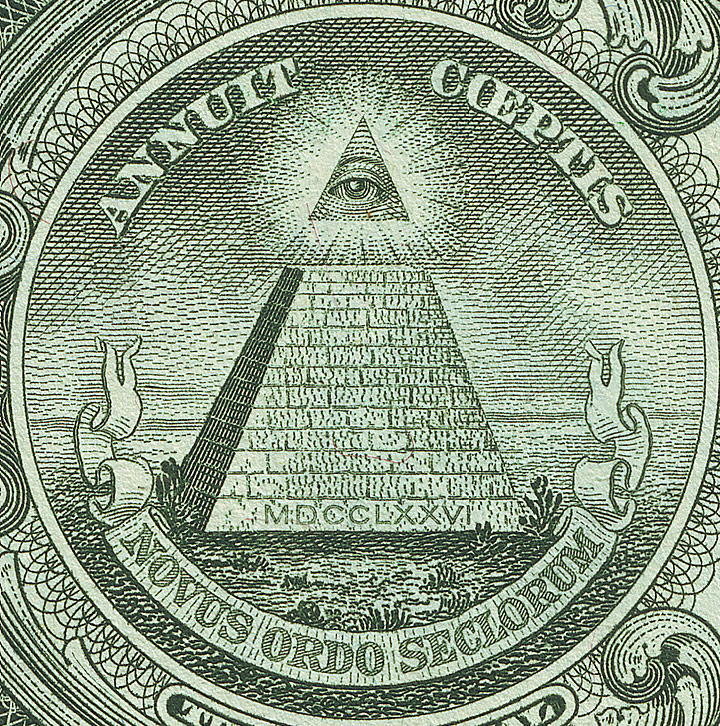
The most durable piece of Illuminati folklore sits in your pocket. On the back of the American one-dollar bill is a pyramid topped by an eye in a glowing triangle, with a Roman numeral date, 1776, at its base. Believers say it is the unmistakable signature of the Bavarian order, and the coincidence of the date, the year Weishaupt founded his society as well as the year of American independence, seems to clinch the case. The record says otherwise. The Eye of Providence was a Christian symbol of divine watchfulness long before 1776, and it was adopted for the reverse of the Great Seal of the United States in 1782, when Weishaupt's order was a small and obscure group in Bavaria. Writers who have studied the Seal's creation find no Illuminati among its designers, and the Masonic organisations that have been accused of influence have explicitly denied any role. The Seal did not even appear on the dollar bill until 1935. In 1934 the Secretary of Agriculture, Henry Wallace, picked up a State Department history of the Seal while waiting for a meeting and suggested it to Franklin Roosevelt, who approved a new design for the note after his Postmaster General assured him that Catholic voters would not object. The eye on your dollar, in other words, is a Depression-era design decision, made a century and a half after the order it supposedly represents had been put out of business.
What they were really for
It is fair to ask what Weishaupt actually wanted, and the honest answer is that historians have never fully agreed. The cheerful reading holds that he was a child of the Enlightenment who hoped to free Bavaria from clerical control and to spread reason, equality and moral improvement through the educated classes, and that his teachings leaned on the Golden Rule and on the supremacy of Reason. A hostile reading, voiced as early as the nineteenth century by Catholic and conservative writers, holds that the true aim was to undermine religion and monarchy and to replace them with a rationalist order run by an elite. Both readings find support in the sources. Members promised to put the interests of the society above their own, a vow that Weishaupt's critics read as a demand for blind obedience, and the order's own rules were so detailed about what members were to read and think that later scholars have called them the opposite of the independent judgment Kant demanded of the Enlightenment. Weishaupt was an educator who thought people could be improved by instruction, and he was also a manager with a secret hierarchy of grades, code names and watchful superiors. That combination of idealism and control makes him a figure of real historical interest, and it explains why even his sympathisers could not agree whether he was a reformer or a schemer.
What scholars do agree about is how little the order accomplished. One assessment finds that after the ban it left no lasting trace of influence, not even on its own former members, who went off in very different directions. Another, written from inside the Masonic world, concludes that the Illuminati had no favourable effect on Freemasonry while they thrived and no unfavourable effect when they were dissolved. The standard reference works agree that the historical record shows no further activity by Weishaupt's Illuminati after 1785, and yet the order has featured prominently in conspiracy theories for more than two centuries. Historians who study the question make a simple point: while real political conspiracies certainly exist and secrecy is often part of political strategy, human beings live in a contingent world and are limited in their ability to steer history. A group that failed to hold together for a decade in a single German state cannot plausibly have controlled the course of world events for two hundred years. The fullest account of the real order is still René Le Forestier's study, first published in French in 1915, translated into English only recently and running to some nine hundred pages. It treats the legend as a subject of its own, with a long section tracing how the Illuminati of fiction and police reports were built, and it preserves the only surviving record of some documents that were destroyed in the two world wars.
What was left
The Illuminati endure because they answer a need that never goes away. Whenever the world feels too complicated, too unfair or too fast, a story that explains it all by pointing to a small group of cunning people is more comforting than the truth, which is that history is a muddle of accidents, blunders and competing interests. The Bavarian order is the perfect vehicle for such a story. Its name is mysterious and its history is half-hidden, its leaders really were secretive, and its real fate, a ban followed by confiscated papers and a scatter of exiles, can always be reinterpreted as a clever disappearance. Each generation has dressed the order in its own fears: the Jacobins of the 1790s, the Bolsheviks of the 1920s, the bankers and diplomats of the Cold War, the pop stars and platforms of the internet age. The pattern has never changed, but the villains have. Meanwhile, the man who started it all lived out his days in Gotha, writing pamphlets that nobody wanted to read and defending a society that no longer existed. One modern writer calls it a tragic irony that a man who tried to teach virtue, philanthropy and social justice has become a hate figure for conspiracy thinkers. It is hard to disagree. The real Illuminati left behind a reading club that grew too fast, a stack of confiscated letters and an unusually good lesson in how easily a small human failure can be turned into an immortal monster. The rest, as the history of the legend shows, was never theirs. It is ours.
Picture notes: Featured image by de:Benutzer:Verwüstung - de:Bild:Dollarnote_siegel_hq.jpg, Public Domain, https://commons.wikimedia.org/w/index.php?curid=2140203. For portraits of Weishaupt, see the engraving after G. V. Mansinger on Wikimedia Commons, the wider Commons category, and the 1787 copperplate in the Bavarian State Library archive.
Sources
- Adam Weishaupt, Wikipedia
- The Illuminati, Encyclopedia.com
- How the secret Illuminati society really did start in Germany, The Local
- Massimo Introvigne on the Illuminati, Bitter Winter
- Illuminati of Bavaria, Grand Lodge of British Columbia and Yukon
- Who are the Illuminati and what do they control?, The Week
- The Man Who Started the Illuminati, Ancient Origins
- Johann Adam Weishaupt, FactGrid
- The Bavarian Illuminati by Rene Le Forestier, Inner Traditions